
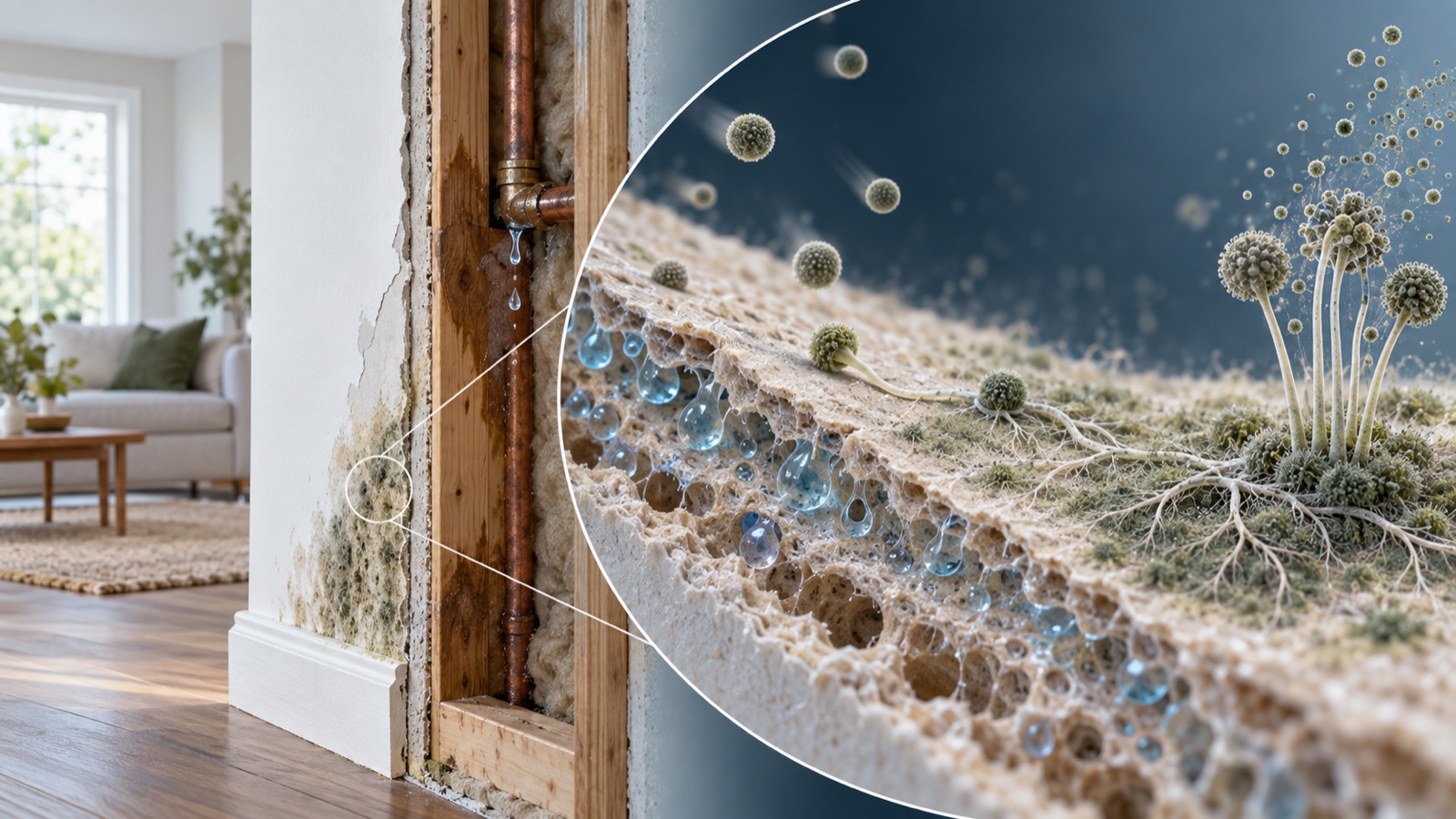
The biology
Spores are common. Persistent moisture changes the story.
Molds are fungi. Their microscopic spores move through indoor and outdoor air and settle on surfaces. When a suitable surface stays damp, a spore can germinate and grow thread-like hyphae that form a network called mycelium.
As a colony matures, it can produce more spores. The practical control point inside a building is not making every spore disappear—it is correcting moisture and addressing affected materials.
“Black mold” is a color description—not a diagnosis.
Many molds appear in multiple colors. Appearance alone does not establish identity or health risk.Common indoor molds
Names matter less than the moisture condition.
CDC identifies Cladosporium, Penicillium, and Aspergillus among common indoor molds. Stachybotrys chartarum is often discussed online, but CDC advises treating its presence like other indoor mold: correct the moisture problem and remove the growth appropriately.
conditions
The control strategy
Remove the water condition, not just the stain.
Indoor molds can use paper, wood, dust, carpet, fabric, and other carbon-containing materials as a food source. Those materials are difficult to eliminate from a building. Excess moisture is the factor we can control.
EPA guidance emphasizes drying wet areas and items within 24–48 hours. That is a prevention target, not a guarantee or a timer for when growth begins.
- Stop the leak or water entry.
- Map where moisture traveled, including hidden assemblies.
- Dry or remove affected materials as conditions require.
- Correct the humidity, condensation, or ventilation cause.
Testing & assessment
A test should answer a real question.
CDC notes that there are no health-based indoor-air standards for mold and does not recommend routine air sampling for building air-quality evaluations. If mold is visible or musty odors and moisture are present, the priority is often source control and a careful physical assessment.
When not to DIY
Complexity matters more than color.
Bring in qualified help when the affected area is extensive, the water may contain sewage or other contamination, HVAC is involved, materials cannot be accessed safely, or occupants have health vulnerabilities or symptoms.
Professional remediation may involve containment, controlled removal, detailed cleaning, drying, and verification. The exact plan should follow the site—not a universal spray-and-paint recipe.
Frequently asked questions
Mold facts without the scare tactics.
Can mold be identified by color?
No. Many molds can appear in several colors, and color does not reliably identify a genus, species, or level of risk. The moisture problem and the affected materials are more useful starting points.
Does every water leak create mold?
Not necessarily. Timing, material, temperature, and moisture conditions all matter. The EPA recommends drying water-damaged areas and items within 24 to 48 hours to help prevent mold growth.
Do I always need mold testing?
No. CDC guidance notes that routine air sampling is generally not recommended for building air-quality evaluations and that there are no health-based indoor-air standards for mold. Testing can be useful in selected situations when it answers a specific question.
When should I call a professional?
Professional help is appropriate when water or mold is extensive, the source is contaminated, materials cannot be safely accessed, HVAC may be involved, or occupants have health concerns. A qualified assessment should start with the moisture source and actual site conditions.
This homeowner guide is informed by the EPA's mold and moisture guidance, CDC mold overview, CDC testing and remediation guidance, and the ANSI/IICRC S520 standard listing.