
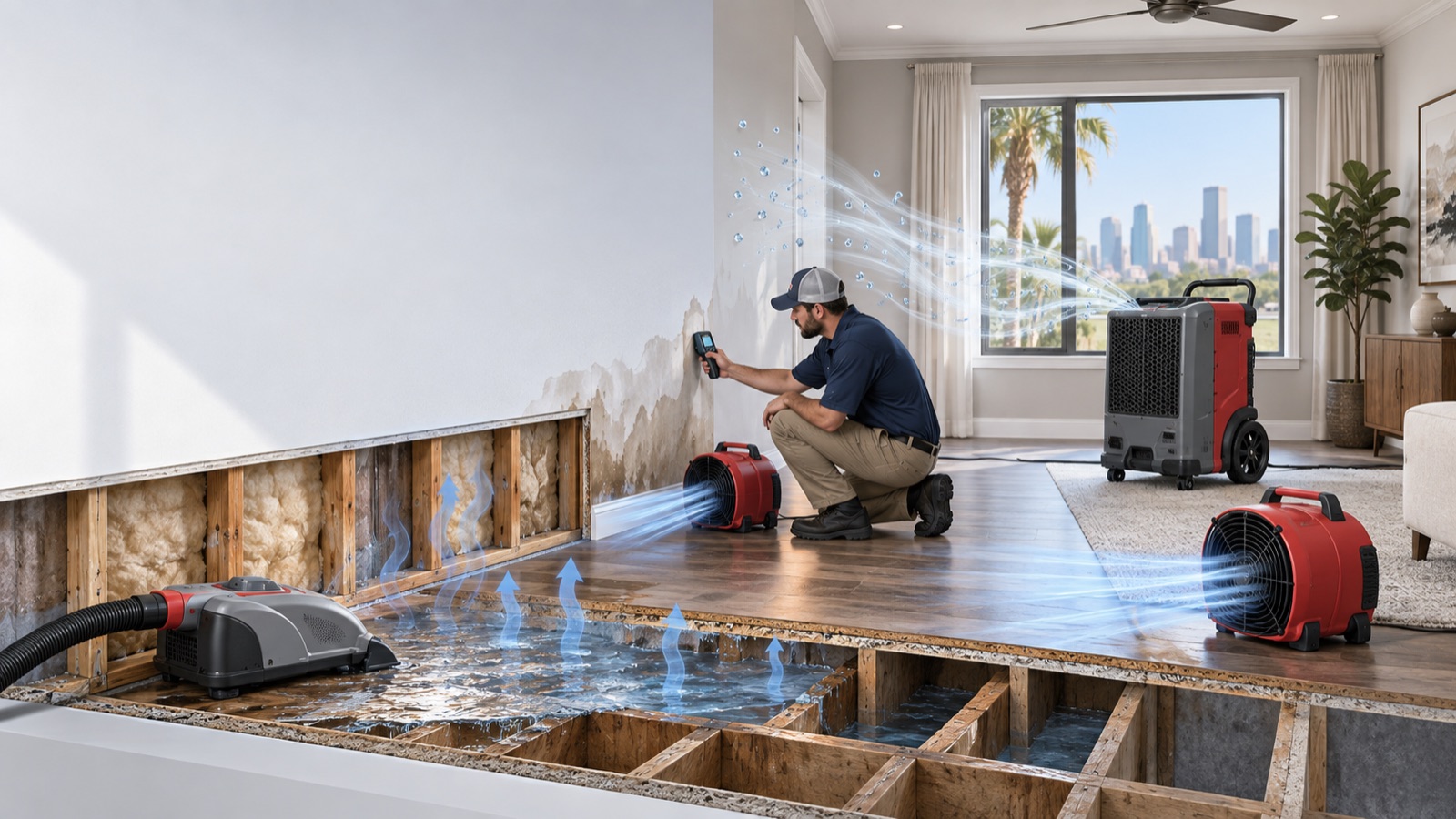
The drying system
Four controls move water from the building to the drain.
Professional drying manages liquid water, water vapor, airflow, and material conditions as one connected system. Changing one part changes the others.
Extract
Remove as much liquid water as practical before relying on evaporation.
Evaporate
Air movement sweeps humid air away from wet material surfaces.
Dehumidify
Dehumidifiers capture water vapor so the air can accept more moisture.
Verify
Material readings show whether the drying plan is actually working.
RH vs. temperature
Relative humidity is relative.
RH compares the water vapor already present with the amount that would saturate the air at its current temperature. If the amount of vapor stays the same, warming the air lowers RH; cooling it raises RH.
That is why an RH number without temperature—or without a dew-point or humidity-ratio reading—can be misleading during a drying job.
No moisture was added or removed—the temperature changed the percentage.
When a surface is at or below the air's dew point, condensation can form.
The condensation line
Dew point connects air conditions to cold surfaces.
Dew point is the temperature at which the air reaches saturation if it is cooled without changing its water-vapor content. It is a more direct indicator of the air's actual moisture content than RH alone.
On a loss, cold supply ducts, slab edges, windows, and exterior walls can become condensation surfaces. Drying equipment must be managed as a system—not simply made hotter.
Moisture mapping
The finish line is measured in materials, not guessed from the air.
Air readings describe the drying environment. Material readings answer the question homeowners care about: is the building assembly returning to an appropriate dry condition?
Record affected rooms, materials, moisture boundaries, and known-dry comparison areas.
Pin, pinless, thermo-hygrometer, and infrared tools answer different questions.
Repeated readings show whether conditions are improving and where the plan needs adjustment.
Thermal imaging shows temperature patterns; moisture meters investigate and confirm what those patterns may mean.
What changes the plan
Materials do not all dry at the same speed.
Paint layers, vinyl coverings, dense wood, insulation, cabinets, multi-layer floors, and wall cavities can slow or redirect drying. The water source and how long it remained also affect what can be safely restored.
- PermeabilityHow easily vapor passes through a material.
- PorosityHow readily a material absorbs and stores water.
- AssemblyLayers can trap moisture even when the face feels dry.
- EnvironmentOutdoor humidity, HVAC, and temperature alter the drying chamber.
Frequently asked questions
Structural drying, without the jargon.
What is structural drying?
Structural drying is the measured removal of excess moisture from building materials and the surrounding air. It combines extraction, controlled airflow, dehumidification, temperature management, and repeated moisture readings.
Why are fans alone not enough?
Air movers help water evaporate from wet surfaces, but that vapor still has to be removed from the air. Without adequate dehumidification and monitoring, moisture can redistribute or condense on cooler surfaces.
How long does structural drying take?
There is no responsible one-size-fits-all answer. The water source, affected materials, assembly depth, weather, access, and initial moisture load all matter. Progress should be based on readings and comparison areas, not the calendar alone.
How do you know a building is dry?
Professionals track affected materials with appropriate moisture instruments and compare results with known-dry materials or justified drying goals. Thermal imaging can help locate patterns, but a moisture meter is used to investigate and confirm them.
This homeowner guide is informed by the ANSI/IICRC S500 Standard overview, EPA guidance on drying buildings, and National Weather Service humidity and dew-point education.